Beyond CRUD: Building Reliable Software Systems · Part 11
New to this series? Start with Part 1
Event-Driven Architecture Explained: Building Systems That React to Events
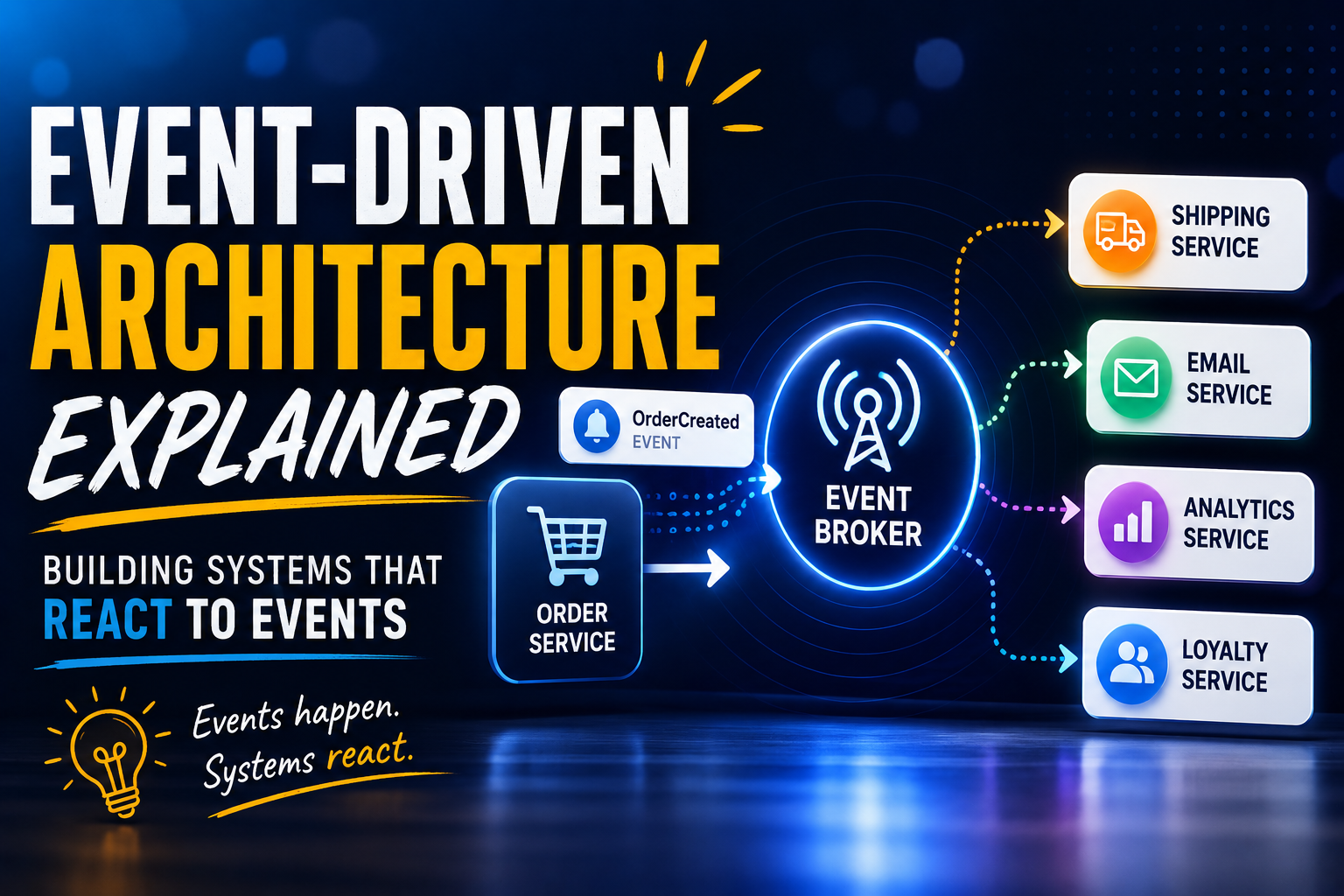
“The most scalable systems don’t constantly ask what’s happening. They simply react when something happens.”
Imagine you’re building an online marketplace. A customer places an order. At first, the workflow seems straightforward. The application creates the order, charges the customer’s card, reserves inventory, schedules shipment, sends a confirmation email, updates analytics, awards loyalty points, and notifies the warehouse. A traditional implementation might have the Order Service call each of these services directly.
1
2
3
4
5
6
7
8
9
10
11
12
13
14
15
Order Service

     │

     ├── Payment Service

     ├── Inventory Service

     ├── Shipping Service

     ├── Email Service

     ├── Analytics Service

     └── Loyalty Service
At first, this architecture feels perfectly reasonable. Each service performs its work and returns a response. As the business grows, however, the Order Service slowly becomes responsible for more and more integrations. Marketing introduces a Recommendation Service, finance adds an Accounting Service, customer success wants a CRM integration, and fraud detection joins the platform. Before long, every new feature requires modifying the Order Service. A service that originally knew only how to create orders now knows almost everything about the entire company. The result is tight coupling. Every new integration increases complexity, every downstream outage affects the original request, and every deployment becomes slightly more risky.
Eventually, developers begin asking a different question. Instead of asking:
“Which services should I call?”
They begin asking:
“What happened?”
That small change in thinking fundamentally changes the architecture. Instead of directly calling every interested service, the Order Service simply announces:
“An order has been created.”
It doesn’t care who listens and doesn’t even know who listens. It simply publishes an event, and every interested service reacts independently. The Shipping Service prepares delivery, the Email Service sends a confirmation, analytics records another sale, loyalty awards points, fraud detection evaluates the transaction, and recommendation engines update customer preferences. The Order Service never calls any of them directly.
This architectural style is known as Event-Driven Architecture (EDA). Instead of services communicating through tightly coupled request-response interactions, they communicate through events describing things that have already happened. This shift may seem subtle, but in reality, it completely changes how distributed systems evolve, scale, and recover from failure.
What Is an Event?
Before discussing Event-Driven Architecture, it’s important to understand what an event actually is. An event is simply a record that something meaningful has already happened. It is not something that might happen, and not something another service should do, but something that has already occurred. Examples include:
- Order Created
- Payment Completed
- Customer Registered
- Loan Approved
- Inventory Reserved
- Shipment Delivered
Notice the wording: every event is written in the past tense because events describe facts. Once an event has occurred, it becomes part of the system’s history. Unlike commands, events don’t tell another service what to do. They simply communicate what has already happened. This distinction is incredibly important. Consider the difference between these two messages.
1
2
3
Command

Charge Customer
1
2
3
Event

Customer Charged
The first message expects another service to perform work; the second informs the rest of the system that the work has already been completed. Commands ask; events announce. That simple distinction lies at the heart of Event-Driven Architecture.
How Event-Driven Systems Work
Imagine a borrower submits a loan application. The Loan Service validates the request, stores the application, and commits its transaction. Rather than directly calling every downstream service, it publishes a LoanApplicationSubmitted event, and from there every interested service works independently.
1
2
3
4
5
6
7
8
9
10
11
12
13
14
15
16
17
18
19
20
21
Loan Service

      │

LoanApplicationSubmitted

      │

──────── Event Broker ────────

      │

      ├── Risk Service

      ├── Notification Service

      ├── Fraud Detection

      ├── CRM

      └── Analytics
Notice what changed: the Loan Service no longer knows anything about these downstream systems. Adding another consumer doesn’t require modifying the Loan Service, and removing one doesn’t either. Every service simply subscribes to the events it cares about. That loose coupling is one of the defining advantages of Event-Driven Architecture.
Why This Improves Scalability
Suppose your application suddenly doubles in size. Marketing introduces three new services, operations introduces two more, and finance adds another. In a request-response architecture, every one of those integrations often requires modifying the originating service. In an event-driven architecture, nothing changes. The new services simply subscribe to existing events, and the publisher remains exactly the same. This dramatically reduces coupling and allows applications to evolve much more independently. Instead of building systems that know about one another, you’re building systems that share facts. That distinction becomes increasingly valuable as applications grow.
Event Brokers: The Backbone of Event-Driven Systems
At this point, a natural question arises. If services no longer call one another directly, how do events actually travel through the system? The answer is an event broker. An event broker acts as the central communication hub for your architecture. Instead of sending events directly to every interested service, a publisher sends the event to the broker, and the broker becomes responsible for delivering it to every subscriber. Conceptually, the architecture looks like this:
1
2
3
4
5
6
7
8
9
10
11
12
13
14
15
16
17
18
19
                Order Service

                     │

      OrderCreated Event

                     │

                     ▼

             Event Broker

     ┌─────────┼─────────┐

     ▼         ▼         ▼

 Inventory   Shipping   Analytics

   Service    Service     Service
Notice what has disappeared: the Order Service no longer knows how many consumers exist, doesn’t know whether the Analytics Service is online, and doesn’t know whether another team introduces a Recommendation Service next month. Its only responsibility is publishing the event. Everything else becomes someone else’s concern. Several technologies can act as event brokers. Apache Kafka is widely used for high-throughput event streaming. RabbitMQ is popular for traditional message queuing. Cloud platforms offer managed services such as Amazon EventBridge, Amazon SQS, Azure Service Bus, and Google Pub/Sub. Each has different strengths, but they all serve the same purpose: moving events from producers to consumers without tightly coupling the two.
Why Event-Driven Architecture Matters
At first glance, publishing events instead of calling APIs might not seem like a revolutionary change. In practice, however, it fundamentally changes how software evolves. Consider our online marketplace again. The Order Service publishes an OrderCreated event. Initially, only three services consume it.
- Shipping
- Inventory
A year later, the business introduces:
- Fraud Detection
- Recommendation Engine
- Customer Rewards
- CRM Integration
- Business Intelligence
- Machine Learning
The Order Service doesn’t change. It continues publishing exactly the same event, and the new services simply subscribe. This is one of the greatest strengths of Event-Driven Architecture: applications grow by adding consumers rather than modifying existing publishers, which greatly reduces the ripple effect of change.
The Trade-Offs
Like every architectural style, Event-Driven Architecture solves some problems while introducing others. One important difference is that communication becomes asynchronous. When a customer places an order, the application may respond immediately even though several downstream services are still processing events. This improves responsiveness but introduces eventual consistency.
For a short period, different services may have slightly different views of the system. The order may already exist while the reporting dashboard hasn’t yet been updated, or the shipment may still be pending while the payment has already completed. This isn’t necessarily a problem; it’s simply a different consistency model, and applications must be designed with that reality in mind. Debugging also becomes more challenging. In a request-response architecture, tracing a workflow often means following a sequence of API calls. In an event-driven architecture, the workflow is distributed across many independent services reacting to events at different times, so good observability becomes essential. Correlation IDs, distributed tracing, structured logging, and monitoring tools become increasingly valuable as systems grow.
Common Mistakes
One of the biggest mistakes teams make is publishing events for everything. Not every database update deserves an event. Good events represent meaningful business occurrences. Examples include:
- Customer Registered
- Order Completed
- Loan Approved
- Payment Received
Poor events often expose internal implementation details. Examples include:
- CustomerTableUpdated
- RowModified
- AddressFieldChanged
Consumers should care about business facts, not database implementation. Another common mistake is assuming events are delivered exactly once. In reality, duplicates can occur, messages can be delayed, and consumers can retry. This is why patterns we’ve already explored, such as Idempotency, remain critically important. Reliable event-driven systems assume events may be delivered more than once and design consumers accordingly. Finally, avoid replacing every API with events. Not every interaction should be asynchronous. Some operations naturally require an immediate response. For example:
- User authentication
- Payment authorization
- Real-time validation
A healthy architecture often combines synchronous APIs with asynchronous events, using each where it makes the most sense.
Request-Response vs Event-Driven
A useful way to compare these architectures is to think about who controls the conversation.
In a request-response system, one service explicitly asks another service to perform work, and the caller waits for an answer before continuing. In an event-driven system, a service simply announces what has already happened. Anyone interested may react, and anyone uninterested simply ignores the event. Neither architecture is universally better. Request-response communication is often simpler and easier to understand, while event-driven communication provides greater flexibility and scalability as systems become more complex. Most modern applications use both. User-facing requests frequently begin as synchronous API calls, and once the business transaction completes, the application publishes events that allow the rest of the system to react independently.
How Everything Fits Together
If you’ve followed this series from the beginning, you’ve probably noticed a pattern. Each article answered a question created by the previous one.
| Concept | Question It Answers |
|---|---|
| Idempotency | What if the same request arrives twice? |
| Race Conditions | What if multiple requests modify the same data? |
| Database Transactions | How do I keep related database operations atomic? |
| Isolation Levels | What should concurrent transactions be allowed to see? |
| Distributed Locks | How do multiple application instances coordinate work? |
| Outbox Pattern | How do I reliably publish events after committing data? |
| Saga Pattern | How do multiple services complete one business process? |
| CQRS | Should reads and writes use the same model? |
| Event-Driven Architecture | How do independent services communicate and evolve together? |
Notice that none of these patterns exists in isolation. An event-driven application might use:
- Idempotency to safely handle duplicate events.
- Transactions to protect local database operations.
- The Outbox Pattern to reliably publish domain events.
- Saga Pattern to coordinate long-running business workflows.
- CQRS to optimize read and write workloads independently.
- Distributed Locks where multiple application instances must coordinate exclusive work.
The real power doesn’t come from mastering one pattern. It comes from understanding how they complement one another.
Final Thoughts
Software architecture isn’t about collecting design patterns. It’s about solving real problems with the right level of complexity. Event-Driven Architecture has become popular because it reflects how modern organizations grow. Teams become independent. Services evolve at different speeds. New features appear continuously. Direct dependencies become increasingly expensive to maintain. By allowing services to communicate through events rather than tightly coupled API calls, Event-Driven Architecture enables systems that are more flexible, more scalable, and more resilient to change. Like every pattern we’ve explored, however, it isn’t a silver bullet. Small applications may never need an event broker, and a well-designed monolith may outperform a poorly designed event-driven system. Architecture should always follow business needs, not trends. The goal isn’t to build the most sophisticated system possible. It’s to build the simplest system capable of solving today’s problem while leaving room for tomorrow’s growth.
Beyond CRUD: Chapter One Complete
When we began this series, we started with a deceptively simple question:
What happens if the same request arrives twice?
From there, we explored race conditions, transactions, concurrency, distributed coordination, reliable messaging, long-running workflows, scalable read models, and event-driven communication. Each article introduced a new piece of the puzzle, and together they form a foundation for understanding how modern backend systems remain reliable under retries, failures, concurrency, and scale.
If there’s one lesson to carry forward, it’s this:
Reliable software isn’t built by avoiding failure. It’s built by expecting failure, understanding where it can occur, and designing systems that recover gracefully when it does.
That mindset, more than any single framework, language, or database, is what separates production-ready systems from code that only works under perfect conditions. The journey beyond CRUD doesn’t end here. It begins here.