Beyond the UI: Understanding Modern Frontend Engineering · Part 10
New to this series? Start with Part 1
Optimistic UI Explained: Making Applications Feel Instant
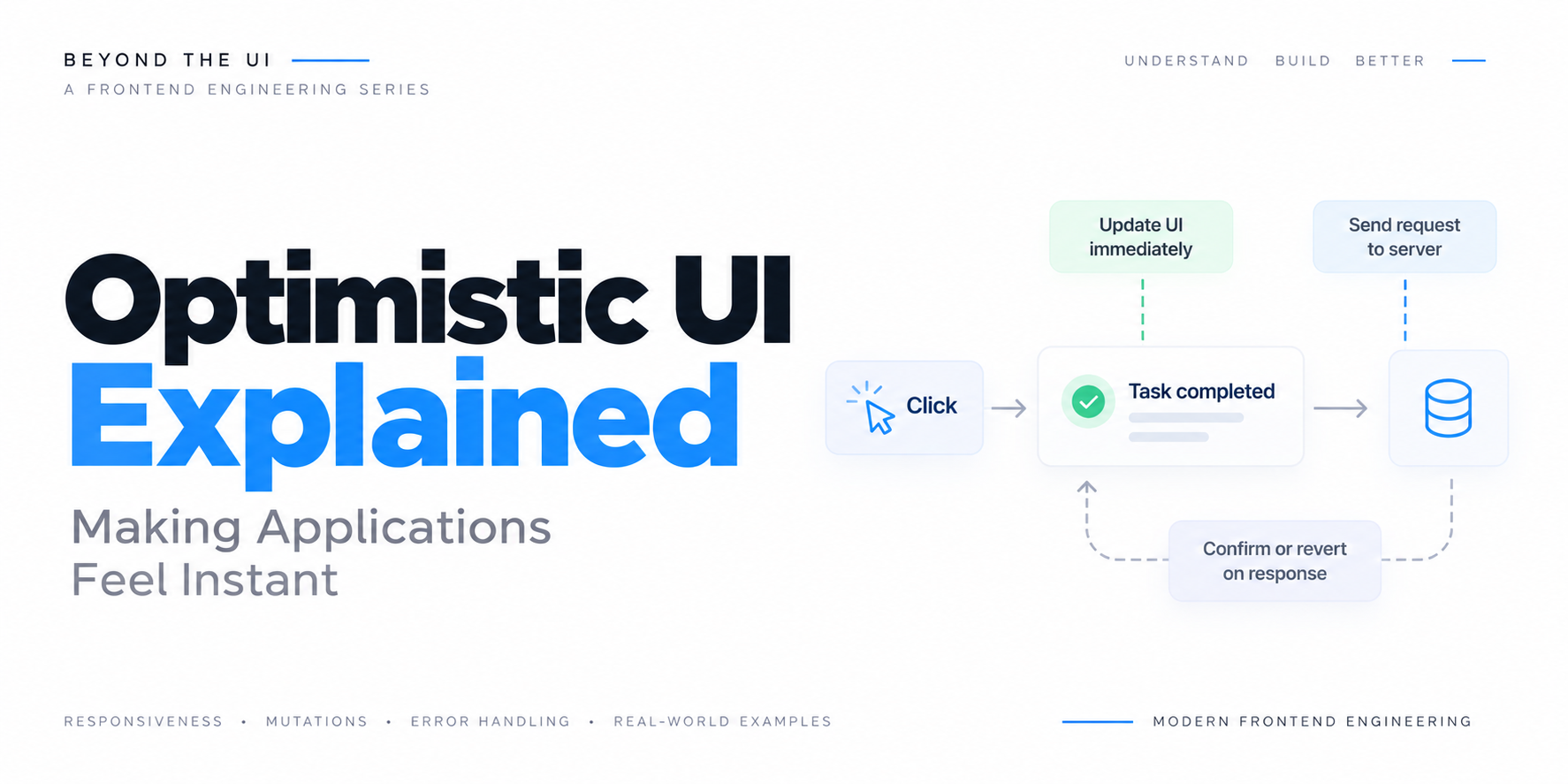
| Beyond the UI: Understanding Modern Frontend Engineering | Part 10 |
Imagine using a task management application where every interaction requires you to wait for the server before anything changes on the screen.
You click a checkbox to mark a task as completed. The application sends a request to the backend, waits for the response, and only then updates the checkbox. You click the button to like a post, and the interface remains unchanged until the server confirms that your reaction was recorded.
Even when the backend responds within a few hundred milliseconds, the experience can feel unnecessarily slow.
The problem is not always the actual speed of the system. Sometimes it is the delay between a user’s action and the application’s visible response.
Modern frontend applications are expected to feel responsive. Users expect buttons to react immediately, forms to acknowledge their actions, and interfaces to reflect changes without unnecessary waiting.
However, there is a fundamental challenge.
Many actions performed in the frontend modify information that the frontend does not own.
A task’s completion status, a social media reaction, a shopping cart stored on the server, or a shared document’s contents may all be controlled by a remote system. The frontend can request changes, but the backend remains responsible for validating and accepting those changes.
This creates a tension between responsiveness and correctness.
If the frontend waits for server confirmation before updating the interface, the experience may feel slow. If it updates immediately, it risks displaying something that the server may ultimately reject.
Optimistic UI is an approach to managing this trade-off.
Instead of waiting for a remote operation to succeed, the frontend immediately displays the result it expects the server to accept. The request continues in the background, and the interface either preserves the optimistic change or reconciles it with the actual server response.
Consider a task that is currently pending.
1
2
Task: Prepare monthly report
Status: Pending
When the user clicks Complete, an optimistic interface immediately displays:
1
2
Task: Prepare monthly report
Status: Completed
Meanwhile, the application sends the update to the backend.
If the server accepts the change, the interface can retain the updated state. If the request fails, the application must decide how to recover.
This sounds straightforward, but real applications introduce complications. Multiple users may modify the same information, network requests may finish out of order, operations may be retried, and the server may return a result that differs from what the frontend predicted.
In the previous article, we explored why server state and client state should not be treated the same. We established that the frontend often holds a local snapshot of information whose authoritative source exists elsewhere.
Optimistic UI builds directly on that distinction.
In this article, we will examine how optimistic updates work, why they improve perceived performance, and how to implement them without sacrificing correctness. We will also explore rollback strategies, concurrent mutations, conflict resolution, and the relationship between optimistic interfaces and distributed systems.
Because making an application feel instant is not simply about updating the screen before a request finishes. It is about designing a system that can recover when its expectations do not match reality.
1. Understanding the Difference Between Actual and Perceived Performance
When discussing frontend performance, we often focus on measurable technical characteristics.
We measure how quickly JavaScript executes, how long network requests take, how efficiently the browser renders content, and how soon an application becomes interactive.
These measurements are important, but they do not fully describe how responsive an application feels.
Consider two applications performing the same operation.
Both send a request that takes 400 milliseconds to complete.
The first application waits for the request before updating the interface.
1
2
3
4
5
6
7
8
9
10
11
12
13
User Action
     |
     v
Send Request
     |
     v
Wait 400ms
     |
     v
Server Responds
     |
     v
Update Interface
The second application updates the interface immediately while the request continues.
1
2
3
4
5
6
7
8
9
10
11
12
User Action
     |
     +--------------------+
     |                    |
     v                    v
Update Interface      Send Request
Immediately               |
                          v
                      Wait 400ms
                          |
                          v
                    Server Responds
The backend performance is identical in both cases.
The network request still takes 400 milliseconds, and the server performs the same operation.
However, the user experiences the second application differently because the interface responds without waiting for the remote operation to complete.
This is an improvement in perceived performance.
Perceived performance concerns how quickly and smoothly an application appears to respond to user interactions. It is influenced by actual execution speed, but also by feedback, animation, progressive rendering, and the timing of visible updates.
Optimistic UI is particularly effective because it removes the server’s response time from the immediate visual feedback path.
That does not make the remote operation faster.
It makes the interface respond before the operation finishes.
The distinction matters because optimistic updates improve responsiveness without necessarily reducing network latency or backend processing time.
2. Pessimistic Updates vs Optimistic Updates
There are two broad approaches to updating an interface after a user requests a remote change.
The first is a pessimistic update.
A pessimistic update waits for the backend to confirm success before changing the displayed authoritative state.
Consider a task completion operation.
1
2
3
4
5
6
7
8
9
10
11
12
13
14
15
16
17
18
19
async function completeTask(taskId) {
  const response = await fetch(`/api/tasks/${taskId}`, {
    method: "PATCH",
    headers: {
      "Content-Type": "application/json"
    },
    body: JSON.stringify({
      status: "completed"
    })
  });

  if (!response.ok) {
    throw new Error("Unable to complete task");
  }

  const updatedTask = await response.json();

  updateTaskInUI(updatedTask);
}
The interface changes only after the server responds successfully.
This approach is relatively easy to reason about because the visible change follows confirmation from the authoritative system.
However, users must wait for the round trip to complete.
An optimistic update reverses the order.
1
2
3
4
5
6
7
8
9
10
11
12
13
14
15
16
17
18
19
20
async function completeTask(taskId) {
  updateTaskInUI({
    id: taskId,
    status: "completed"
  });

  const response = await fetch(`/api/tasks/${taskId}`, {
    method: "PATCH",
    headers: {
      "Content-Type": "application/json"
    },
    body: JSON.stringify({
      status: "completed"
    })
  });

  if (!response.ok) {
    throw new Error("Unable to complete task");
  }
}
This illustrates the immediate update, but it is not yet a complete implementation because failures are not handled.
The essential difference is the order of operations.
1
2
3
4
5
6
7
8
9
10
11
12
13
14
15
16
17
18
19
20
21
22
23
24
25
26
PESSIMISTIC UPDATE

User Action
     |
     v
Request Server
     |
     v
Server Confirmation
     |
     v
Update UI


OPTIMISTIC UPDATE

User Action
     |
     v
Update UI
     |
     v
Request Server
     |
     v
Confirm or Reconcile
Neither approach is universally better.
Pessimistic updates are useful when displaying an unconfirmed result would be misleading or dangerous.
Optimistic updates are useful when the operation is predictable, failures are relatively uncommon, and the application can recover safely.
The correct choice depends on the consequences of being wrong.
3. Optimistic UI Is a Prediction
The most useful mental model for optimistic UI is to think of it as a prediction.
When a user performs an action, the frontend predicts what the resulting server state will look like.
It then displays that prediction before receiving confirmation.
For example, suppose a social media post has 42 likes.
1
2
3
4
5
{
  "postId": 15,
  "likedByCurrentUser": false,
  "likeCount": 42
}
The user clicks Like.
The frontend predicts that the operation will succeed.
1
2
3
4
5
{
  "postId": 15,
  "likedByCurrentUser": true,
  "likeCount": 43
}
The interface displays the predicted result immediately.
The server may later confirm it, reject it, or return a different authoritative count because other users have interacted with the post.
This means an optimistic value is not necessarily the same thing as confirmed server state.
Conceptually, the application is working with two related representations.
1
2
3
4
5
6
7
8
9
10
11
12
13
               Confirmed Server State
                         |
                         v
                    Local Snapshot
                         |
                         v
                   User Mutation
                         |
                         v
                  Optimistic State
                         |
                         v
                    Displayed UI
When the server responds, the application reconciles the optimistic representation with the confirmed result.
This distinction becomes especially important when several mutations are pending simultaneously.
If we treat every optimistic value as though it were already authoritative, we lose the information needed to recover correctly.
4. The Lifecycle of an Optimistic Mutation
An optimistic update usually moves through several stages.
First, the user initiates an action.
The frontend then applies a predicted change to the local representation of the relevant data.
Next, it sends a mutation request to the backend.
Finally, the application processes the response and either confirms the optimistic change, replaces it with authoritative information, or recovers from failure.
1
2
3
4
5
6
7
8
9
10
11
12
13
14
15
16
17
18
19
20
21
22
23
24
25
26
27
                  User Action
                       |
                       v
                Capture Current State
                       |
                       v
               Apply Optimistic Change
                       |
                       v
                  Update Interface
                       |
                       v
                 Send Mutation
                       |
                 +-----+-----+
                 |           |
                 v           v
              Success      Failure
                 |           |
                 v           v
             Reconcile    Recover or
             with Server   Roll Back
                 |           |
                 +-----+-----+
                       |
                       v
                 Final UI State
The most important step is reconciliation.
A successful HTTP response does not necessarily mean that the frontend’s predicted result exactly matches the authoritative result.
For example, a server may normalize values, calculate additional fields, assign identifiers, or apply business rules.
The frontend should therefore treat the server response as the authoritative outcome rather than assuming that its optimistic prediction was perfectly accurate.
5. Building a Basic Optimistic Update
Let’s implement a simple optimistic task update using ordinary JavaScript.
Assume the application maintains a local list of tasks.
1
2
3
4
5
6
7
8
9
10
11
12
let tasks = [
  {
    id: 1,
    title: "Prepare monthly report",
    status: "pending"
  },
  {
    id: 2,
    title: "Review invoices",
    status: "pending"
  }
];
We want to mark a task as completed immediately, while the request runs in the background.
A first implementation might look like this.
1
2
3
4
5
6
7
8
9
10
11
12
13
14
15
16
17
18
19
20
21
22
23
24
25
26
27
28
29
30
31
32
33
34
35
36
37
38
39
40
async function completeTask(taskId) {
  const previousTasks = tasks;

  tasks = tasks.map(task =>
    task.id === taskId
      ? { ...task, status: "completed" }
      : task
  );

  renderTasks(tasks);

  try {
    const response = await fetch(`/api/tasks/${taskId}`, {
      method: "PATCH",
      headers: {
        "Content-Type": "application/json"
      },
      body: JSON.stringify({
        status: "completed"
      })
    });

    if (!response.ok) {
      throw new Error("Unable to update task");
    }

    const confirmedTask = await response.json();

    tasks = tasks.map(task =>
      task.id === taskId ? confirmedTask : task
    );

    renderTasks(tasks);
  } catch (error) {
    tasks = previousTasks;
    renderTasks(tasks);

    showError("The task could not be updated.");
  }
}
This implementation demonstrates the basic pattern.
The application captures the previous state, applies the optimistic update, sends the request, and restores the previous state if the operation fails.
For a simple demonstration with one pending mutation at a time, this works conceptually.
However, it has a serious limitation.
If another update occurs while the request is pending, restoring the entire previous task list may overwrite that newer change.
This is why snapshot-based rollback requires careful design.
The next sections explore how these complications arise.
6. Rollback Is More Complicated Than Restoring Old State
Imagine a task list containing two tasks.
1
2
Task A: Pending
Task B: Pending
The user marks Task A as completed.
The frontend optimistically updates it.
1
2
Task A: Completed
Task B: Pending
Before the server responds, the user also completes Task B.
1
2
Task A: Completed
Task B: Completed
Now suppose the request for Task A fails, while the request for Task B succeeds.
If the application restores the entire snapshot captured before Task A’s mutation, it may produce:
1
2
Task A: Pending
Task B: Pending
That is incorrect because Task B was successfully completed.
The rollback for Task A has accidentally undone an unrelated successful change.
1
2
3
4
5
6
7
8
9
10
11
12
13
14
15
16
17
18
19
20
21
22
23
24
25
26
Initial State
A: Pending
B: Pending
     |
     v
Optimistic A
A: Completed
B: Pending
     |
     v
Optimistic B
A: Completed
B: Completed
     |
     v
A Fails, B Succeeds
     |
     v
Restore Entire Old Snapshot
     |
     v
A: Pending
B: Pending
     |
     v
Incorrect Result
A better strategy is to make rollback as narrow as possible.
Instead of restoring the entire collection, the application should recover the specific data affected by the failed mutation.
For independent task records, this may mean restoring only the failed task.
For more complicated relationships, the application may need to replay pending mutations on top of the latest confirmed state.
This is an important principle.
An optimistic mutation should not undo changes that occurred independently after it began.
7. A More Reliable Model: Confirmed State and Pending Mutations
One way to reason about concurrent optimistic updates is to separate confirmed server state from pending local operations.
Instead of repeatedly modifying one shared object and hoping rollback works, we maintain a confirmed representation and derive the displayed state by applying pending mutations.
Conceptually:
1
2
3
4
5
6
7
8
9
10
                 Confirmed State
                       |
                       v
                Pending Mutation A
                       |
                       v
                Pending Mutation B
                       |
                       v
                 Displayed State
Suppose the confirmed task state is:
1
2
3
4
const confirmedTasks = [
  { id: 1, status: "pending" },
  { id: 2, status: "pending" }
];
The application also maintains pending operations.
1
2
3
4
5
6
7
8
9
10
11
12
const pendingMutations = [
  {
    mutationId: "mutation-1",
    taskId: 1,
    status: "completed"
  },
  {
    mutationId: "mutation-2",
    taskId: 2,
    status: "completed"
  }
];
We can derive the optimistic view by applying the pending mutations to the confirmed data.
1
2
3
4
5
6
7
8
9
function applyPendingMutations(tasks, mutations) {
  return mutations.reduce((currentTasks, mutation) => {
    return currentTasks.map(task =>
      task.id === mutation.taskId
        ? { ...task, status: mutation.status }
        : task
    );
  }, tasks);
}
Now the displayed state is calculated from two explicit sources.
1
2
3
4
const displayedTasks = applyPendingMutations(
  confirmedTasks,
  pendingMutations
);
If one mutation fails, the application removes that mutation from the pending collection and recalculates the displayed state.
This avoids blindly restoring an old snapshot of the entire application.
The model is not a complete production synchronization engine. Mutations affecting the same entity may still require ordering, version checks, and conflict resolution.
Nevertheless, it provides a stronger conceptual foundation.
Rather than treating optimistic state as permanently replacing confirmed state, we treat it as a temporary layer applied over the latest known authoritative information.
8. Concurrent Mutations and Out-of-Order Responses
Network requests do not necessarily complete in the order they were initiated.
This becomes particularly important when multiple optimistic mutations affect the same record.
Imagine a user rapidly toggling a task between completed and pending.
The application sends two requests.
1
2
Request A: Set status to completed
Request B: Set status to pending
The user’s final intention is to leave the task pending.
However, the requests may complete in a different order.
1
2
3
4
5
6
Time
 |
 v

Request A: Completed  --------------------> Response A
Request B: Pending         ------> Response B
If the frontend blindly applies each response as it arrives, the older response may overwrite the newer intention.
The same issue can occur on the backend if both requests execute concurrently and there is no mechanism for enforcing the intended order.
This is an important distinction.
Preventing stale responses from updating the frontend does not automatically prevent stale requests from modifying server state.
A client-side request identifier can protect the visible interface.
1
2
3
4
5
6
7
8
9
10
11
12
13
14
15
16
17
18
19
20
21
22
23
24
25
26
27
let latestMutationId = 0;

async function updateTaskStatus(taskId, status) {
  const mutationId = ++latestMutationId;

  applyOptimisticStatus(taskId, status);

  const response = await fetch(`/api/tasks/${taskId}`, {
    method: "PATCH",
    headers: {
      "Content-Type": "application/json"
    },
    body: JSON.stringify({ status })
  });

  if (!response.ok) {
    throw new Error("Update failed");
  }

  const confirmedTask = await response.json();

  if (mutationId !== latestMutationId) {
    return;
  }

  applyConfirmedTask(confirmedTask);
}
This simplified example uses one global counter, so it would be appropriate only for a single independently managed mutation stream. An application with multiple tasks would generally track mutation versions per entity.
More importantly, the backend still needs to handle conflicting or reordered operations correctly.
Depending on the domain, the application may serialize mutations, use record versions, enforce conditional updates, or adopt an explicit conflict-resolution policy.
Optimistic UI does not eliminate concurrency problems.
It makes them more visible because the frontend is presenting predicted outcomes before the authoritative system has resolved them.
9. Versioning and Optimistic Concurrency Control
One way to prevent outdated updates from overwriting newer information is optimistic concurrency control.
Despite the similar terminology, optimistic concurrency control and optimistic UI solve different problems.
Optimistic UI concerns when the interface displays an expected result.
Optimistic concurrency control concerns whether an update is allowed to proceed when the underlying record may have changed.
Consider a task returned by an API.
1
2
3
4
5
6
{
  "id": 42,
  "title": "Prepare monthly report",
  "status": "pending",
  "version": 7
}
The frontend knows that it is working with version 7.
When updating the task, it includes the expected version.
1
2
3
4
5
6
7
PATCH /api/tasks/42
Content-Type: application/json

{
  "status": "completed",
  "expectedVersion": 7
}
The backend checks whether the current record is still version 7.
If it is, the update can proceed and the version can advance.
If another client has already modified the record, the backend may reject the update with a conflict response.
1
2
3
4
5
6
7
8
9
10
11
12
13
14
15
16
Client Reads Version 7
          |
          v
Client Requests Update
Expected Version: 7
          |
          v
Backend Checks Version
          |
      +---+---+
      |       |
    Match   Mismatch
      |       |
      v       v
   Accept   Conflict
   Update   Response
A conflict response might use HTTP 409, while APIs using conditional requests with headers such as If-Match may use HTTP 412 when the precondition fails.
The frontend can then retrieve the latest record and determine how to reconcile the user’s intended change.
This approach is especially valuable in collaborative systems where multiple clients may modify the same data.
It also illustrates why optimistic interfaces require cooperation between frontend and backend architecture.
The frontend can predict an outcome, but the backend must still enforce the rules that determine whether the outcome is valid.
10. Idempotency and Safe Retries
Optimistic updates frequently involve retries.
A request may time out, the user’s connection may drop, or the application may be uncertain whether the backend processed an operation.
Consider a payment request.
The frontend sends the request, but the connection closes before the response arrives.
The application does not know whether the payment succeeded.
If it blindly sends the same request again, it risks creating a duplicate payment unless the backend provides appropriate safeguards.
This is where idempotency becomes important.
An idempotent operation can be repeated without producing additional effects beyond the intended result.
For operations that create new resources or financial transactions, APIs can support idempotency keys.
1
2
3
4
5
6
7
8
POST /api/payments
Content-Type: application/json
Idempotency-Key: payment-attempt-123

{
  "amount": 1500,
  "currency": "KES"
}
If the client retries with the same idempotency key and the same intended operation, the backend can recognize that the request represents an existing attempt.
A correctly implemented idempotency mechanism can prevent duplicate processing and return the recorded outcome.
However, idempotency keys require backend support. Simply adding a header does not make an endpoint idempotent.
The backend must store or otherwise reliably track operation identities, handle concurrent duplicates, define retention rules, and ensure that the intended side effect is not performed more than once.
This connects optimistic UI to a broader distributed-systems principle.
A frontend may not always know whether a request succeeded, especially when the response is lost.
Reliable systems must distinguish between retrying an operation and accidentally creating a second operation.
11. Not Every Operation Should Be Optimistic
Optimistic UI works best when the expected outcome is predictable and the consequences of displaying an incorrect result are manageable.
Liking a post is a good example.
The operation is relatively simple, and if it fails, the application can usually restore the previous reaction state and inform the user.
Changing a task’s completion status may also be suitable, depending on the application’s collaboration requirements.
Financial transactions are more complicated.
Imagine a user transferring KES 50,000 between accounts.
If the frontend immediately displays a successful transfer before the backend confirms it, the user may believe the money has moved when the transaction has actually failed.
That would be misleading and potentially harmful.
A better design can still provide immediate feedback without pretending the operation has completed.
1
2
3
4
5
6
7
8
9
10
11
12
13
14
15
User Initiates Transfer
          |
          v
Show Processing State
          |
          v
Send Request
          |
      +---+---+
      |       |
   Success   Failure
      |       |
      v       v
   Confirm   Explain
   Transfer  Failure
The interface can respond instantly by showing that the request has been received or is being processed.
But it should reserve a confirmed success state for an authoritative response.
This highlights an important distinction between immediate feedback and optimistic success.
An application can feel responsive without falsely representing an unconfirmed operation as completed.
The correct strategy depends on the business consequences of an incorrect prediction.
12. Designing Failure Recovery
When an optimistic operation fails, the application needs to recover in a way that preserves both correctness and user trust.
A basic rollback may be sufficient for a simple reaction button.
If a Like request fails, the interface can restore the previous state and display a brief error message.
For more complicated actions, recovery may require a different approach.
Consider an application where a user edits a long description.
If the save request fails, simply restoring the old server value would discard the user’s work.
A better design may preserve the unsaved draft and allow the user to retry.
1
2
3
4
5
6
7
8
9
10
11
12
13
User Edits Description
          |
          v
Optimistic Display
          |
          v
Save Request Fails
          |
          v
Preserve User Draft
          |
          v
Show Retry Option
This distinction matters because rollback is not always equivalent to recovery.
Rollback restores an earlier state.
Recovery aims to preserve correctness while minimizing unnecessary loss of user intent.
In some cases, restoring the old state is appropriate.
In others, the application should preserve the user’s changes, mark them as unsaved, and provide a clear path to retry or resolve the conflict.
Good optimistic interfaces therefore need domain-specific failure strategies rather than a universal rollback function.
13. Temporary Identifiers and Optimistic Creation
Optimistic updates are not limited to modifying existing records.
Applications may also optimistically create new items before the server assigns their permanent identifiers.
Consider a messaging interface.
When the user sends a message, the application may immediately display it in the conversation.
However, the server has not yet created the authoritative message record.
The frontend can assign a temporary identifier.
1
2
3
4
5
const optimisticMessage = {
  id: "temp-123",
  text: "Hello, how are you?",
  status: "sending"
};
The interface displays the message immediately.
1
2
Hello, how are you?
Sending...
The application then sends the request.
1
2
3
4
5
6
7
8
9
10
11
12
13
14
15
16
17
18
19
20
21
22
23
24
25
26
27
28
29
30
31
32
33
34
35
36
37
async function sendMessage(text) {
  const temporaryId = crypto.randomUUID();

  const optimisticMessage = {
    id: temporaryId,
    text,
    status: "sending"
  };

  addMessageToUI(optimisticMessage);

  try {
    const response = await fetch("/api/messages", {
      method: "POST",
      headers: {
        "Content-Type": "application/json"
      },
      body: JSON.stringify({
        text,
        clientMutationId: temporaryId
      })
    });

    if (!response.ok) {
      throw new Error("Unable to send message");
    }

    const confirmedMessage = await response.json();

    replaceTemporaryMessage(
      temporaryId,
      confirmedMessage
    );
  } catch (error) {
    markMessageAsFailed(temporaryId);
  }
}
When the backend responds, the frontend replaces the temporary record with the authoritative one.
1
2
3
4
5
6
7
8
9
10
11
Optimistic Message
ID: temp-123
Status: Sending
          |
          v
Server Response
ID: 9876
Status: Sent
          |
          v
Reconcile Record
The clientMutationId can help correlate the local attempt with the server response if the backend supports it. It is not automatically an idempotency guarantee.
The application must also avoid displaying duplicate messages if the server sends the newly created message through a real-time subscription before the original request completes.
This is another example of why optimistic UI becomes more complicated when multiple synchronization mechanisms interact.
14. Optimistic Updates and Real-Time Applications
Real-time applications introduce additional challenges because server updates may arrive while optimistic mutations are still pending.
Imagine a collaborative task board.
Client A optimistically marks a task as completed.
Before the mutation response arrives, Client B changes the task’s priority.
The backend then broadcasts an updated task record to all connected clients.
The frontend must reconcile its pending local mutation with the incoming server update.
1
2
3
4
5
6
7
8
9
10
11
12
13
14
15
16
17
18
19
20
                    Backend
                       |
                Broadcast Update
                       |
                       v
                   Client A
                       |
              +--------+--------+
              |                 |
              v                 v
       Pending Local       Incoming Server
          Mutation             State
              |                 |
              +--------+--------+
                       |
                       v
                  Reconciliation
                       |
                       v
                   Displayed UI
Blindly replacing the local task with the incoming server record may erase the optimistic status change.
Blindly preserving the optimistic record may ignore the priority update from another user.
A more robust approach separates confirmed server data from pending local operations and derives the displayed state from both.
When authoritative updates arrive, the application updates the confirmed base and reapplies pending operations where appropriate.
However, this approach still requires conflict policies when multiple operations modify the same field.
The correct behavior depends on the application’s consistency requirements.
For a simple task board, the application may accept last-write-wins behavior.
For collaborative document editing, more sophisticated techniques such as operational transformation or conflict-free replicated data types may be appropriate.
Optimistic UI is therefore closely related to the broader challenge of reconciling concurrent changes in distributed applications.
15. Optimistic UI and Offline Applications
Offline-capable applications often use optimistic updates because the network may be unavailable when users perform actions.
Consider a field-service application used in an area with unreliable connectivity.
A technician updates a job status while offline.
The application can immediately reflect the change locally and queue the operation for synchronization.
1
2
3
4
5
6
7
8
9
10
11
12
13
14
15
16
17
18
19
20
21
22
23
24
25
User Updates Job
        |
        v
Update Local UI
        |
        v
Store Pending Operation
        |
        v
Network Available?
        |
    +---+---+
    |       |
   No      Yes
    |       |
    v       v
  Wait    Synchronize
    |       |
    +---+---+
        |
        v
Server Confirmation
        |
        v
Reconcile State
This provides a usable interface even without continuous connectivity.
However, offline optimistic updates introduce additional complexity.
Operations may remain pending for hours. The server data may change before synchronization occurs. Multiple queued operations may depend on one another, and some operations may fail permanently.
The application may need a durable mutation queue, retry policies, conflict detection, and clear indicators showing which changes are synchronized.
It must also distinguish between locally saved changes and server-confirmed changes.
For example, a job record could display:
1
2
Status: Completed
Sync Status: Pending
This allows the interface to respond immediately without misleading the user about whether the remote system has accepted the update.
16. Optimistic UI Across Frontend Frameworks
Optimistic UI is a general application design pattern rather than a feature belonging to one frontend framework.
The underlying lifecycle remains similar regardless of whether an application uses React, Angular, Vue, Svelte, or plain JavaScript.
The differences lie in how each framework represents reactive state and coordinates updates.
React
React applications can implement optimistic updates through local state, state-management libraries, or server-state libraries such as TanStack Query.
React also provides useOptimistic for representing optimistic state during asynchronous actions.
A simplified example looks like this:
1
2
3
4
5
6
7
8
9
10
11
12
13
14
15
16
17
18
19
20
21
import { useOptimistic } from "react";

function Task({ task, updateTask }) {
  const [optimisticTask, setOptimisticTask] =
    useOptimistic(task);

  async function completeTask() {
    setOptimisticTask({
      ...optimisticTask,
      status: "completed"
    });

    await updateTask(task.id, "completed");
  }

  return (
    <button onClick={completeTask}>
      {optimisticTask.status}
    </button>
  );
}
This illustrates the intended optimistic state transition, but a production implementation must follow the relevant React version’s Action requirements and handle errors and authoritative state updates correctly. In React versions where useOptimistic updates must occur within an Action, the update should be coordinated through that mechanism rather than treated as an ordinary arbitrary state setter.
TanStack Query provides another approach by allowing applications to optimistically update cached query data and recover if mutations fail.
Angular
Angular applications can implement optimistic updates using signals, services, and RxJS.
A service may update local reactive state immediately, send a request through HttpClient, and restore or reconcile the state depending on the response.
The framework provides the reactive primitives, while the application or a supporting library implements the mutation lifecycle.
Vue
Vue applications can implement optimistic updates using reactive state, Pinia, or query libraries.
A local reactive collection can be updated immediately while an asynchronous request runs.
On success, the application reconciles the local state with the server response. On failure, it applies an appropriate recovery strategy.
Svelte
Svelte applications can use reactive state and framework-specific data-loading mechanisms to implement optimistic interfaces.
In SvelteKit, form actions and progressive enhancement provide mechanisms for handling submissions, while application-specific optimistic behavior can update the visible interface before the action completes.
The Shared Principle
Regardless of framework, the architecture follows the same general pattern.
1
2
3
4
5
6
7
8
9
10
11
12
13
14
15
16
                  User Action
                       |
                       v
                 Local Prediction
                       |
                       v
                  Immediate UI
                       |
                       v
                 Remote Mutation
                       |
                       v
                 Server Response
                       |
                       v
                   Reconcile
The framework determines how state changes are represented and rendered.
The application architecture determines how predictions, failures, concurrency, and authoritative updates are handled.
Understanding that distinction makes optimistic UI easier to implement across different technologies.
17. Measuring the Value of Optimistic UI
Optimistic UI primarily improves perceived responsiveness, but its effectiveness should still be evaluated.
One useful measurement is the time between a user action and the first meaningful visual response.
For a pessimistic interface, that delay may include the entire network round trip.
For an optimistic interface, it may consist primarily of local JavaScript execution and rendering.
However, measuring only the initial response time can be misleading.
An interface that responds instantly but frequently rolls back changes may feel unreliable.
We should therefore consider several dimensions of the experience.
The first is immediate feedback latency, which measures how quickly the interface acknowledges the user’s action.
The second is mutation success rate, which helps determine how often optimistic predictions are confirmed.
The third is rollback or recovery frequency, which reveals how often users experience visible corrections.
The fourth is reconciliation stability, which concerns whether server responses cause unexpected flickering, duplicate records, or incorrect state transitions.
Finally, we should consider user comprehension. A fast interface is not necessarily a good interface if users cannot tell whether their changes have been saved.
The goal is to improve responsiveness while preserving a clear relationship between predicted and confirmed outcomes.
18. Common Mistakes When Implementing Optimistic UI
One common mistake is treating optimistic state as though it were confirmed server state.
This can cause applications to display successful operations that have not actually completed.
Another mistake is implementing rollback by restoring an entire outdated snapshot. This may accidentally erase unrelated changes that occurred while the mutation was pending.
A third mistake is ignoring concurrent mutations. When multiple requests affect the same record, response order may differ from user action order, producing inconsistent results.
Applications may also forget to reconcile optimistic values with the server’s authoritative response. This becomes particularly problematic when the backend assigns identifiers, normalizes data, or applies additional business rules.
Another common problem is retrying operations without considering idempotency. If a request times out after the backend has already processed it, a retry may accidentally repeat the side effect.
Finally, some applications use optimistic success indicators for operations that should require authoritative confirmation.
The interface may feel fast, but the user can be misled about whether an important operation actually succeeded.
These mistakes share a common cause.
They treat optimistic UI as a visual trick rather than a synchronization strategy.
A reliable implementation must account for the full lifecycle of the mutation, including failure and reconciliation.
19. Choosing When to Use Optimistic UI
The decision to use optimistic updates should begin with the nature of the operation.
A useful question is whether the application can safely predict the result and recover if the prediction is wrong.
Consider several common interactions.
| Operation | Typical strategy | Reason |
|---|---|---|
| Liking a post | Optimistic | Easy to reverse, relatively low consequence |
| Marking a task complete | Often optimistic | Predictable outcome with manageable recovery |
| Sending a chat message | Optimistic with pending status | Immediate feedback while preserving delivery status |
| Updating a profile field | Depends on validation | Server may reject or normalize the value |
| Reserving limited inventory | Usually confirmation-based | Availability may change concurrently |
| Transferring money | Confirmed success required | Incorrect success feedback has serious consequences |
| Deleting a draft | Often optimistic with recovery | May support undo or restoration |
| Publishing regulated information | Usually confirmation-based | Validation and authorization may be essential |
These are general patterns rather than universal rules.
A task-management application with strict approval workflows may require confirmation before displaying a task as completed.
A messaging application may optimistically display a message but clearly mark it as sending until the server acknowledges receipt.
The correct strategy depends on the domain, the likelihood of failure, and the consequences of an incorrect prediction.
20. A Better Mental Model for Optimistic UI
Rather than treating optimistic updates as a simple technique for making interfaces faster, it is more useful to think of them as temporary local predictions layered over authoritative remote information.
1
2
3
4
5
6
7
8
9
10
11
12
13
14
15
16
17
18
19
20
21
22
23
24
25
26
27
28
                  Confirmed Server State
                           |
                           v
                     Local Snapshot
                           |
                           v
                    User Intention
                           |
                           v
                   Optimistic Mutation
                           |
                           v
                      Displayed UI
                           |
                           v
                    Server Processes
                           |
                    +------+------+
                    |             |
                 Accepted       Rejected
                    |             |
                    v             v
                Reconcile      Recover
                    |             |
                    +------+------+
                           |
                           v
                    Consistent UI
This model makes several responsibilities explicit.
The frontend needs to preserve the distinction between confirmed and predicted information.
It needs a way to identify pending operations.
It must reconcile authoritative responses without overwriting unrelated changes.
It must recover from failures without unnecessarily discarding user intent.
And it must communicate enough information for users to understand whether an action is pending, confirmed, or unsuccessful.
Once these responsibilities are recognized, optimistic UI becomes easier to reason about as an architectural pattern rather than a collection of event handlers.
Bringing It All Together
Optimistic UI connects several concepts we have explored throughout this series.
State management determines how the frontend represents local information and propagates changes.
Re-rendering explains how state updates become visible in the interface.
Memoization helps avoid unnecessary repeated computation when those updates occur.
Server-state management explains why the frontend cannot assume that locally stored remote information remains authoritative.
Optimistic UI builds on all these ideas by allowing the frontend to temporarily display predicted outcomes while remote mutations are still being processed.
1
2
3
4
5
6
7
8
9
10
11
12
13
14
15
16
17
18
19
20
21
22
23
24
25
26
                     User Interaction
                              |
                              v
                       Local State Update
                              |
                              v
                       Optimistic Result
                              |
                              v
                         Render UI
                              |
                              v
                       Remote Mutation
                              |
                    +---------+---------+
                    |                   |
                    v                   v
               Server Accepts      Server Rejects
                    |                   |
                    v                   v
                Reconcile            Recover
                    |                   |
                    +---------+---------+
                              |
                              v
                       Consistent State
The immediate visual response improves perceived performance, but the system still needs to preserve correctness.
This is where optimistic UI intersects with distributed-systems engineering.
Network requests can fail or arrive out of order. Multiple clients can modify the same record. Retries can duplicate operations. Local predictions can conflict with authoritative server rules.
A reliable optimistic interface must therefore coordinate local state, pending mutations, and server responses.
The more collaborative or consequential the application becomes, the more important these coordination mechanisms are.
Optimistic UI works best when it is deliberately designed around the expected failure modes of the operation.
Final Thoughts
Optimistic UI is one of the most effective ways to make an application feel responsive without requiring every backend operation to become instantaneous.
By updating the interface before the server responds, the frontend can remove network latency from the immediate feedback experience.
However, this responsiveness comes with additional responsibility.
The frontend is making a prediction about the outcome of a remote operation, and predictions can be wrong.
A well-designed optimistic interface understands that distinction. It preserves enough information to recover from failures, handles concurrent mutations carefully, reconciles server responses, and avoids presenting unconfirmed operations as authoritative success when the consequences would be significant.
This is why optimistic UI should not be treated as a universal replacement for waiting on server confirmation.
For simple, reversible interactions, it can make an application feel dramatically smoother.
For high-stakes operations, immediate feedback may still be valuable, but confirmed success should remain tied to the authoritative system.
The real engineering challenge is deciding which outcomes can be safely predicted and designing recovery mechanisms for the situations where those predictions fail.
Ultimately, good optimistic UI is not about pretending that the network is instantaneous.
It is about acknowledging the user’s intention immediately while preserving the system’s ability to reach a correct and consistent state.
Because the best interfaces respond quickly, but they also know how to recover when reality disagrees with their expectations.
What’s Next?
Next in Beyond the UI: Understanding Modern Frontend Engineering:
Frontend Caching Explained: Making Applications Fast Without Serving Stale Data
Throughout this article, we explored how frontend applications can update their interfaces before remote operations are confirmed.
But responsiveness is not only about mutations.
Modern applications also spend considerable time retrieving information, downloading resources, and repeating requests for data that may already be available locally.
Caching helps reduce that repeated work, but it introduces a different challenge.
How do we know whether the information we are reusing is still valid?
In the next article, we will explore the different layers of frontend caching, including browser caches, HTTP caching, CDNs, application caches, and server-state query caches.
We will examine cache-control policies, expiration, invalidation, conditional requests, and the trade-offs between speed and freshness.
Because a fast response is only useful when the information it delivers is still appropriate to trust.